
History
History
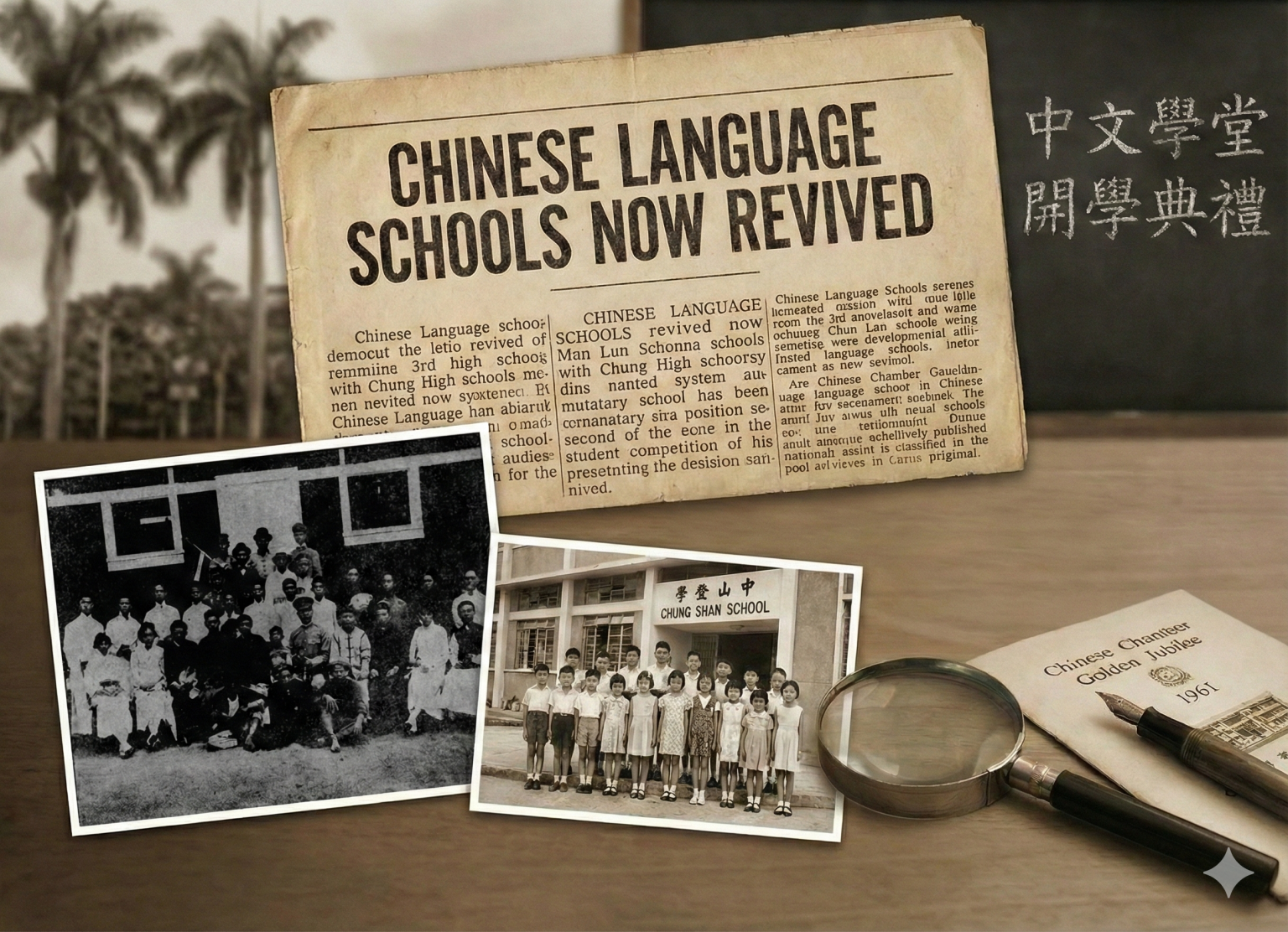
Heritage & Resilience: The 1961 Revival of Chinese Language Schools in Hawaii
A historical summary based on the “Chinese Chamber Golden Jubilee” (1961) and original reporting by Morris Lai
Historical Background: From Sojourners to Settlers
In the late 19th century, despite a Chinese population of over 6,000 in Hawaii, formal language schools were non-existent. Education was primarily provided by Christian mission schools supported by government grants.
Why the delay? The early immigrants possessed a “sojourner” mentality—most were men who did not plan to stay in Hawaii permanently and therefore did not invest in local infrastructure.
However, as the early 1900s arrived, a shift occurred. With second and third generations growing up in the islands, elders feared the youth were adopting “foreigners’ ways.” To bridge the gap between the children in Hawaii and the villages in China, the community began to mobilize.
The “Surviving Seven” Schools of Oahu
By 1934, there were 19 Chinese language schools in the Territory. By 1961, following World War II and various legal battles, only seven remained—all located on Oahu.
1. Chung Shan (Sun Yat Sen School)
Established: Classes began Feb. 8, 1911 (originally named “Wah Mun”).
The History: The school was suggested in 1909 by Dr. Sun Yat Sen himself to train Chinese leaders versed in the cultures of both East and West.
1961 Status: With approximately 435 pupils, the school was facing a major transition as the Honolulu Redevelopment Agency acquired their property, necessitating a move to a new location.
2. Mun Lun School
Established: Founded Feb. 4, 1911, by the Mo Hock Ke Lock Bo Club.
Peak Growth: By 1936, Mun Lun was the largest Chinese educational institute in the U.S., boasting 1,348 students and a 12-year curriculum.
Resilience: In 1931, a fire caused $20,000 in damages. The community rallied, replacing the destroyed wooden buildings with a concrete structure. By 1961, enrollment had stabilized at nearly 500 students.
3. Tai Koong
Location: 1023-A 6th Ave.
Growth: Founded in 1951 with just 40 students, it grew rapidly to 240 students by 1961.
4. Kong Chung
Established: 1953 near St. Louis High School.
Leadership: Founded by Chung Kin Wong, who served as both principal and teacher from the beginning.
5. Hoo Cho School
Origin: Established by the Hoo Cho Young Men’s Club on Johnson Lane.
1961 Status: Served approximately 100 students.
6. Wahiawa Wah Mun
Community Roots: Sponsored by the local community association, this school had been operating for 35 years as of 1961.
7. Waianae Chinese School
The Newcomer: Started around 1956 by principal Kwong Han Tsang to serve the Leeward coast, with about 30 students enrolled.
Challenges and Legal Battles
The survival of these schools was not guaranteed. They faced two major existential threats during the mid-20th century:
The WWII Shutdown & Legal Redemption All language schools were forced to close during World War II. They remained shuttered until 1947 due to a Territorial “anti-foreign language school bill.” The schools only reopened after the bill was ruled unconstitutional, marking a significant legal victory for cultural preservation in Hawaii
Archive
2019 CLEAH History by Prof. JIANG Wenyan
Prof. Jiang Wenyan is with the Beijing Foreign Studies University, which partnered with the University of Hawai‘i at Mānoa to run the Confucius Institute at UHM. In 2019, she interviewed key members of CLEAH to write this essay.